

Soda-lime Glass Tubes
ZCP is located in Chongqing City,China.Its Chinese full name is Chongqing Zhengchuan Pharmaceutical packaging Co., Ltd.ZCP specializes in the R&D and production of pharmaceutical tubular glass vials and caps almost 40 years.The company has four branch factories,intelligent stereoscopic warehouses,and over 2,000+employees. In the year of 2017,ZCP became the first private enterprise in pharmaceutical glass packaging field to be listed in the main stock market in China.
Why Choose Us
High Production Capacity
The company has four branch factories and three large-sized production bases, covering a land of more than 200,000 m2. The company has 8 furnaces to produce glass tubing and more than 600 sets of high-precision devices used for production of vials and caps.
Broad Market
Relying on its great production capacity and famous brand, Zhengchuan has established a nationwide sales service network and has established long-term friendly cooperation relations with more than four hundred customers in China, which makes the company enjoy a good reputation at home and abroad.
Our products sell well in several regions in the world, e.g. South America, Southeast Asia, Europe and Asia.
Wide Product Range
The company possesses a modern technology research & development center and an integrated manufacturing center of pharmaceutical glass tubing, glass vials and auxiliary caps. The company mainly produces various types of transparent and amber tubular glass injection vials, tubular glass oral liquid vials, tubular glass screwed-neck vials and ampoules.
Quality Assurance
All products would enter a closed warehouse directly from the workshop via mechanical automation, so as to eliminate pollution sources due to transport of products and entrance of staffs and reduce the percentage of pollution and damage of products.
All procedures are controlled by computer that connected with the Intranet of the company. It could realize the integration of management and control, achieve clear entry and stock out in warehouses, and eliminate the risks of wrong or mixed delivery of products.
-
 Pharmaceutical Amber Soda Lime Glass TubingWe can supply Pharmaceutical Amber Soda Lime Glass Tubes for vials.Add to Inquiry
 -
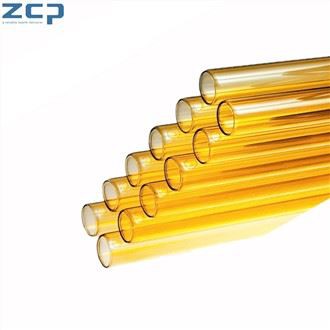 Amber Soda Lime Glass TubingWe're known as one of the most professional amber soda lime glass tubing manufacturers and suppliers in China.Add to Inquiry


Soda-lime Glass Tube is a cost-effectively tube which is made from the most commonly available glass and contains both sodium and calcium. This type of glass is used for windows in buildings, bottles and jars and can also be used cost-effectively to make tubes, rods, plates, spheres and finished glassware components. Although it will not withstand as high a temperature as borosilicate glass, it can still be successfully used for many different scientific and industrial applications.
Soda-lime glass tubes is made on a big percent and used for bottles, drinking cup , and windows. light transmission properties and low melting temperature of the soda-lime glass, the most important is the lowest price make it suitable for use as industry glass and window glass, etc . Its smooth and non-reactive surface makes it excellent as containers for sight glass.
Benefits of Soda-Lime Glass Tubes
It’s cheap.
Soda-Lime Glass Tubes is less expensive than other glass with more specialized properties, such as borosilicate or optical glass.
It’s chemically stable.
The atoms in Soda-Lime Glass Tubes have strong atomic bonds and are highly connected, making it difficult for other substances to affect its structure and corrode the glass. This makes it good for use around chemicals, especially if tempered to increase its thermal shock resistance. Soda-Lime Glass Tubes is not entirely immune to chemical wear, however, and other more specialized glasses can be more resistant.
It’s hard.
Soda-Lime Glass Tubes is a 6-7 on the Mohs hardness scale, which measures how resistant to abrasion material is. This highest score on this scale is ten and includes materials like diamond. Soda-Lime Glass Tubes can also, however, be tempered by heat or chemicals to be made three times stronger. Chemical tempering gives it more mechanical strength, making it harder and more scratch-resistant. Heat strengthening also provides the glass with mechanical strength, with the bonus of making it more resistant to sudden changes in temperature.
It’s vulnerable to thermal shocks.
Sudden temperature changes can shatter Soda-Lime Glass Tubes. This can be reduced by heat tempering, which gives this material added strength.
It’s an electrical insulator.
Glass does not transmit electricity well, as it has a high specific resistivity and a low dielectric constant. That makes it useful for insulating electrical products.
What Makes Up Soda-Lime Glass Tubes?
As mentioned above, the primary composition of Soda-Lime Glass Tubes are silica, soda, and lime. However, it misses out one of the most helpful articles that make it different from other glass types – broken glass shards.
Silica (Sand)
Silica, which is commonly derived from sand, is the principal component of Soda-Lime Glass Tubes, making up the bulk of its composition. It offers transparency and acts as the structural underpinning for the glass.
Sodium Carbonate (Soda)
Also known by the name soda, serves as a flux in the glass-making operation. It is the ingredient responsible for the lowering of the melting point of silica, which, in turn, makes it simpler to shape, form, and customize.
Calcium Oxide (Lime)
Out of all these three, lime (calcium oxide) is the one that helps increase the durability and resilience of the glass to environmental influences. Fun fact, lime is also one of the primary ingredients needed to make cement and high-grade steel.
Glass Shards
Last but most definitely not least are the glass shards. During the melting process, glass shards are added to increase the volume of the results. Since they contain silica and calcium oxide, they also help in the strengthening of the final product.
What to Consider in Choosing Soda-Lime Glass Tubes
Not all Soda-Lime Glass Tubes are created equally. Some are manufactured with better and more accuracy and precision than most. Before you ink a deal with a manufacturer or supplier, it’s important that you understand the considerations of choosing soda-lime glass first.
Manufacturer or Supplier
The first consideration you want to look at would be the manufacturer or supplier. Is your manufacturer certified? How experienced is your manufacturer’s team in producing soda-lime glass?
Understanding your supplier’s capabilities is one way of ensuring that you will be getting only the best and highest quality of finished soda-lime glass products.
Size Availability
Some manufacturers have size limits because of the manufacturing plant or the area they operate in. You’ll want to choose the supplier that can give you flexible sizes of Soda-Lime Glass Tubes for you to make minor adjustments when needed.
Lead Times
Last but most definitely not least is to choose a manufacturer that has considerate lead times. Working with a manufacturer with less flexible lead times often result in rushed work, which is bad for your business because it will be low quality.
You want to check each manufacturer’s lead time first before you sign or agree to anything. Aim for a lead time that won’t exceed 2 months for you to get the ball rolling as fast as you can.

Borosilicate glass is an “engineered “glass developed specifically for use in laboratories and applications where thermal, mechanical and chemical conditions are too harsh for standard, household-type soda-lime glass. It is a type of glass with silica and boron trioxide as the main glass-forming constituents. Borosilicate glasses are resistant to thermal shock more than other kinds of common glass. It can go from freezer to oven and back again. Its high thermal résistance is due to having very low coefficients of thermal expansion. It is typically used for the construction of reagent bottles because it is less subject to thermal stress and meets the demand of most laboratories.
Soda-Lime Glass
Soda-lime glass is the most prevalent type of glass. This is also known as Soda-lime-silica glass. It is usually used for windowpanes and glass containers such as bottles and jars for beverages, food, and some commodity items. Soda-lime glass accounts for about 90% of manufactured glass.
Comparison
Silicon Dioxide SiO2, Boron Trioxide B2O3, Sodium Oxide Na2O, and Aluminium Oxide Al2O3 are four compounds of both Soda-lime glass and Borosilicate glass. However, the proportion of each is different in Borosilicate glass and Soda-lime glass. The mixture in Borosilicate glass binds all the chemicals more tightly together, leading to a much higher melting point. Borosilicate glass has a higher proportion of silicone dioxide than Soda Lime glass (80.6% in Borosilicate glass and 69% in Soda-lime glass).
Thermal resistance
One of the differences between Soda-lime glass and Borosilicate glass is their thermal resistance. Borosilicate glass has a lower CTE (Coefficients of Linear Thermal Expansion) than soda-lime glass (about one-third that of ordinary soda-lime glass). Thus, Borosilicate glass is more resistant to thermal shock, therefore, is usually used for glassware that may be directly heated, such as beakers or boiling flasks while Soda Lime glass is used for glassware which is not likely to be directly and strongly heated, for example, Petri dishes, TLC chromatography tanks and volumetric glassware.
Hardness
In terms of hardness, Borosilicate glass is harder, stronger and more durable than Soda-lime glass. According to the Mohs scale of mineral hardness, diamond’s rate is 10, chalk is 1, borosilicate comes in at 7.5 and the other types of glass at 6. Borosilicate glass is less dense (about 2.23 g/cm3) than typical soda-lime glass due to the low atomic mass of boron.
Plasticity
The lower CTE (Coefficients of Linear Thermal Expansion) in Borosilicate glass can be modelled into complex shapes like vacuum flasks.
Resistance to Acids
Borosilicate glass is more resistant to the acidotic chemical than Soda-lime glass and It is more suitable to be utilised in the chemistry laboratories where the acidic and alkaline solutions are used.
Application of Soda-Lime Glass Tubes
Low to Moderate Temperature Applications
Soda-lime glass tubes can effectively handle environments with low to moderate temperature ranges. It is suitable for tanks that do not experience extreme temperature fluctuations, ensuring stable performance without the risk of thermal shock.
Non-Corrosive Environments
Soda-lime glass tubes has moderate chemical resistance, making it suitable for tanks that do not contain aggressive or highly corrosive substances. It performs well in environments where the risk of chemical degradation is minimal.
Cost-Sensitive Applications
For applications where budget constraints are a significant consideration, Soda-lime glass tubes offers a cost-effective solution. Its lower production cost compared to borosilicate glass makes it an attractive option for less demanding uses.
Visual Inspection and Monitoring
Soda-lime glass tubes provides good optical clarity, making it useful for applications where visual inspection and monitoring of the tank contents are necessary. It allows operators to easily observe the liquid level and condition within the tank.
Low-Pressure Environments
In applications where tanks operate under low pressure, sodalime glass can provide adequate performance without the need for the enhanced strength offered by borosilicate glass. It can safely handle the pressure conditions typical of these environments.
Industries That Must Use Borosilicate Glass
It is crucial to note that the FDA only recommends borosilicate glass for industries related to food, pharmaceuticals, and other regulated areas due to its superior properties. Borosilicate glass offers exceptional chemical resistance, thermal stability, and durability, making it the preferred choice for these critical applications.
Comparing soda-lime glass and borosilicate glass is not aligned enough to go toe-to-toe with each other. For one, both these materials are used for varying applications–using them for whatever the other glass type’s purpose is wrong.
Another is because they’re not the same type of glass and they are typically made independently. The components of borosilicate glass aren’t the same with soda-lime glass. They are chemically and mechanically different.
So, to answer the question – yes, soda-lime glass is better than borosilicate glass in some aspects like price, availability, and ease of acquisition. But the answer is no because physically, chemically, and mechanically, borosilicate glass units are far more superior than soda-lime glass, but they’re too expensive and takes too long to manufacture.
Our Factory
Our company is the first to build a 3d warehouse in the same industry in China, mechanical automation closed warehouse, dust free storage, reducing the risk of mis-sending and mixing.


Certificate

FAQ
We're well-known as one of the leading soda-lime glass tubes manufacturers and suppliers in China. If you're going to buy high quality soda-lime glass tubes, welcome to get more information from our factory. Also, customized service is available.
